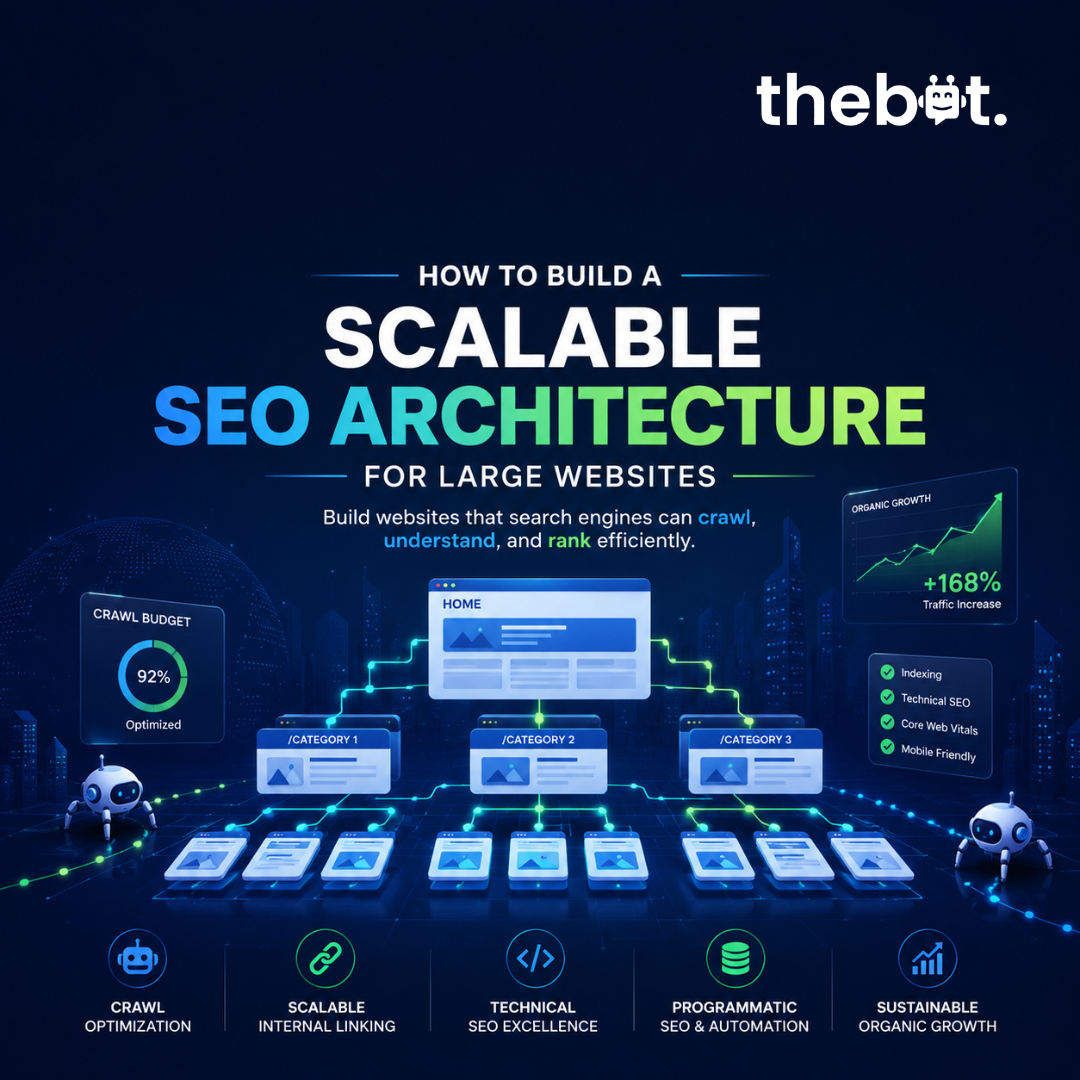
How to Build a Scalable SEO Architecture for Large Websites | SEO Growth Guide
In this article:
Learn how to build a scalable SEO architecture for large websites to improve crawlability, rankings, indexing, and long-term organic growth. Discover proven strategies, technical SEO solutions, and scalable frameworks for enterprise websites.
Introduction
As websites grow, SEO becomes increasingly complex. What works for a small website with a few pages often fails for platforms managing thousands — or even millions — of URLs. Large websites face challenges such as crawl inefficiencies, duplicate content, weak internal linking, indexing issues, and inconsistent site structures. Without a scalable SEO architecture, even valuable content may struggle to rank effectively.
For enterprises, eCommerce brands, SaaS companies, publishers, and marketplaces, SEO architecture is not just about improving rankings — it directly influences discoverability, user experience, lead generation, and long-term organic growth.
A strong SEO foundation ensures that search engines can efficiently crawl, understand, and prioritize the most important pages on a website while delivering a seamless experience to users.
Problem Statement
As websites scale, several common SEO problems begin to emerge:
1. Crawl Budget Wastage
Search engines allocate limited crawl resources to every website. Poor URL structures, duplicate pages, unnecessary filters, and parameterized URLs can waste crawl budgets and prevent important pages from being indexed properly.
2. Weak Internal Linking
Large websites often develop inconsistent internal linking structures over time. Important pages become buried deep within the site, reducing their visibility and authority.
3. Duplicate & Thin Content
Expanding websites frequently generate duplicate pages through faceted navigation, pagination, category overlaps, or CMS-generated variations. This creates confusion for search engines and dilutes ranking potential.
4. Unorganized Site Taxonomy
Without a logical hierarchy, users struggle to navigate the website and search engines struggle to understand page relationships and topical relevance.
5. Technical SEO Complexity
Managing technical SEO across thousands of pages becomes increasingly difficult. Canonicals, redirects, structured data, XML sitemaps, Core Web Vitals, and JavaScript rendering require scalable systems rather than manual fixes.
These challenges can significantly reduce organic visibility, lower conversion opportunities, and slow down overall business growth.
How We Solve It
Building a scalable SEO architecture requires a combination of technical expertise, strategic planning, and automation.
1. Structured Website Hierarchy
A clear and logical site architecture improves both user navigation and search engine crawlability. Proper categorization ensures authority flows efficiently across the website.
2. Scalable Internal Linking Frameworks
Automated and strategic internal linking helps search engines discover high-priority pages while improving topical relevance and user engagement.
3. SEO-Friendly URL Structures
Clean, descriptive, and scalable URLs improve usability and make it easier for search engines to understand page context.
4. Technical SEO Optimization
Scalable technical SEO solutions include:
- XML sitemap optimization
- Canonical management
- Crawl budget optimization
- Structured data implementation
- Mobile-first optimization
- Page speed improvements
5. Programmatic SEO & Automation
For large websites, automation becomes essential. Programmatic SEO allows businesses to efficiently create optimized landing pages at scale while maintaining consistency and quality.
6. Continuous Monitoring & Optimization
SEO architecture requires ongoing monitoring to track crawl behavior, indexing trends, ranking performance, and technical health over time.
To identify hidden SEO issues and opportunities on your website, start with a free audit:
https://freeaudit.thebot.agency/
Case Study
Scaling Organic Growth for a Large eCommerce Website
A rapidly growing eCommerce platform faced major SEO challenges despite publishing hundreds of new pages every month.
Challenges:
- Over 500,000 indexed URLs with duplication issues
- Weak internal linking across product and category pages
- Crawl inefficiencies caused by faceted navigation
- Slow-loading pages impacting rankings
- Poor category hierarchy affecting discoverability
Solution:
The SEO architecture was rebuilt to improve scalability and search performance:
- Simplified category and product taxonomy
- Consolidated duplicate pages using canonical strategies
- Implemented automated internal linking systems
- Optimized crawl paths for search engines
- Improved technical performance and Core Web Vitals
Results:
Within 8 months:
- Organic traffic increased significantly
- Crawl efficiency improved dramatically
- High-priority pages achieved stronger rankings
- Organic revenue growth accelerated
- Overall indexing quality improved
This demonstrated how a scalable SEO architecture can directly impact traffic, visibility, and business growth.
Conclusion
A scalable SEO architecture is essential for large websites that want sustainable organic growth. Without a strong structural foundation, websites often struggle with indexing inefficiencies, weak rankings, poor user experience, and missed conversion opportunities.
By investing in scalable SEO systems, businesses can:
- Improve crawl efficiency
- Strengthen keyword rankings
- Enhance user experience
- Increase organic traffic
- Support long-term digital growth
Large-scale SEO success is not achieved through isolated optimizations — it requires a well-planned architecture that can grow alongside the business.
If you want to uncover technical SEO issues and growth opportunities on your website, get a free audit here:
https://freeaudit.thebot.agency/
Frequently Asked Questions
Scalable SEO architecture is a structured framework that helps large websites manage crawlability, indexing, internal linking, and content organization efficiently as the website grows.
Large websites often contain thousands of pages, making it difficult for search engines to crawl and index content properly. A strong SEO architecture improves visibility, rankings, user experience, and organic traffic growth.
Common challenges include crawl budget wastage, duplicate content, weak internal linking, poor site hierarchy, slow page speed, and technical SEO management across large numbers of URLs.
Internal linking helps search engines discover important pages, distribute authority across the website, improve user navigation, and strengthen topical relevance.
Programmatic SEO uses automation and templates to create optimized landing pages at scale, helping large websites expand content efficiently while maintaining SEO consistency.