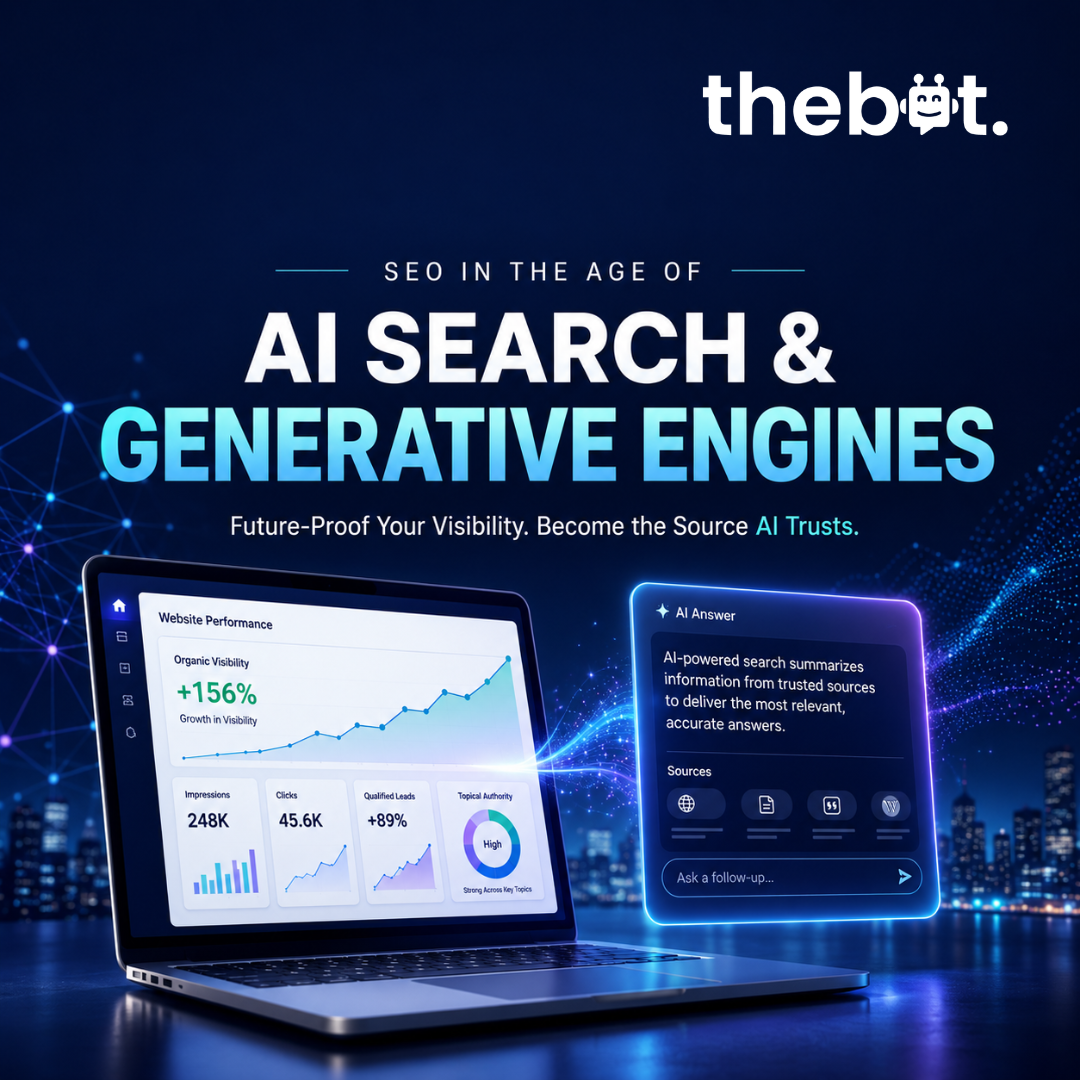
SEO strategy for AI-powered search and generative engines. Optimize for ChatGPT, Perplexity, Claude, and future AI search platforms.
Introduction
Search is evolving faster than ever. With the rise of AI-powered search experiences and generative engines, users are increasingly receiving direct, conversational answers instead of traditional lists of website links. Platforms powered by large language models can synthesize information from multiple sources, helping users find answers faster and more efficiently.
This shift is changing how businesses approach online visibility. Ranking on search engines remains important, but brands must now also ensure their content is discoverable, understandable, and trustworthy enough to be referenced by AI systems. As generative search becomes more prevalent, organizations need to rethink their SEO strategies to remain competitive.
Problem Statement
Many businesses continue to rely on SEO strategies designed for traditional search engines. While these methods still have value, they may not be sufficient in an environment where AI engines generate answers instead of simply displaying links.
Common challenges include:
Declining Organic Traffic
AI-generated responses can answer user questions directly, reducing the need for users to click through to websites.
Reduced Brand Visibility
Even businesses with strong search rankings may not appear in AI-generated responses if their content lacks authority, context, or structured information.
Changing User Behavior
Users are increasingly searching with natural language questions rather than short keyword phrases, requiring a different content strategy.
Lack of AI Search Readiness
Many websites are not optimized for how generative engines evaluate, understand, and surface content.
Without adapting to these changes, businesses risk losing visibility, traffic, and potential customers as AI-powered search continues to grow.
How We Solve
To succeed in the age of AI search, businesses need a strategy that goes beyond traditional SEO.
Our approach focuses on:
Building Topical Authority
Creating comprehensive, trustworthy content that demonstrates expertise and provides complete answers to user questions.
Optimizing for Conversational Search
Developing content that aligns with how people naturally ask questions and how AI engines interpret intent.
Strengthening Technical Foundations
Ensuring websites are properly structured, easy to crawl, fast-loading, and enriched with relevant schema markup.
Enhancing Entity Recognition
Helping search engines and AI systems clearly understand a brand, its services, and its expertise.
Continuous Performance Analysis
Monitoring visibility across evolving search environments and refining strategies based on emerging trends and opportunities.
By combining technical SEO, content strategy, and AI-focused optimization, businesses can improve their chances of being surfaced and referenced in generative search results.
Case Study
B2B Technology Company Expands Visibility Beyond Traditional Search
A growing B2B technology company noticed that while its website ranked well for several competitive keywords, overall lead generation had plateaued.
Challenges
- 1Strong keyword rankings but limited growth in qualified traffic
- 2Minimal visibility within emerging AI-powered search experiences
- 3Content focused heavily on keywords rather than comprehensive answers
- 4Increasing competition from larger industry players
Solution
- 1Expanding content depth and topical coverage
- 2Optimizing pages for conversational search queries
- 3Improving technical SEO and structured data
- 4Strengthening authority signals across key topics
Results
Within several months, the company experienced:
- 1Increased visibility across AI-driven search experiences
- 2Improved engagement from high-intent visitors
- 3Growth in qualified lead generation
- 4Stronger authority within its industry niche
The company was able to future-proof its search strategy and improve discoverability across both traditional and AI-powered search environments.
Conclusion
SEO is no longer just about ranking higher on search engines. In the era of AI search and generative engines, businesses must focus on becoming trusted sources of information that AI systems can confidently understand, reference, and recommend.
Organizations that adapt early will be better positioned to capture visibility, traffic, and customers as search continues to evolve. The key is building a strategy that combines authoritative content, technical excellence, and AI search optimization.
Want to know how prepared your website is for AI-powered search?
Get a free website audit today:
Ready to Discuss Your Business Goals?
Connect with our experts for a free consultation. We'll understand your business, discuss your challenges, and recommend practical strategies and technology solutions to help you achieve sustainable growth.
Frequently asked questions
QWhat is AI Search Optimization?
AI Search Optimization is the process of optimizing content, website structure, and authority signals so that AI-powered search engines and generative platforms can understand, reference, and recommend your business in their responses.
QHow is AI search different from traditional search engines?
Traditional search engines primarily provide a list of ranked links, while AI search engines generate direct answers by analyzing and synthesizing information from multiple sources. This changes how users discover content and interact with brands online.
QWill traditional SEO still matter in the age of AI search?
Yes. Traditional SEO remains important because AI systems still rely on many of the same signals, including quality content, website performance, authority, and structured data. However, businesses must also optimize for conversational search and AI discoverability.
QWhy is my website not appearing in AI-generated search results?
Common reasons include weak topical authority, insufficient content depth, poor technical SEO, lack of structured data, inconsistent brand signals, and content that does not effectively answer user intent.
QHow can businesses prepare for the future of AI-powered search?
Businesses should focus on creating authoritative content, improving technical SEO, optimizing for conversational queries, strengthening entity recognition, and regularly auditing their website's AI search readiness.